

Google and Microsoft now give website owners more ways to see whether their content appears in AI-powered search experiences. That’s progress. But if you own a law firm, construction business, or high-end event venue, a new analytics chart still does not answer the most important question: Is your search visibility generating the kinds of inquiries you actually want?
My answer is to measure AI visibility and business outcomes separately, then connect them carefully. Track when your website appears; track who contacts you; and track which inquiries become qualified consultations, proposals, projects, or bookings. Do not assume that one automatically causes the other.
There’s a reason this distinction matters now. Pew Research Center analyzed Google search behavior from a panel of 900 U.S. adults in March 2025. People clicked a traditional result in 8% of visits that included an AI summary, compared with 15% of visits without one. Those figures describe observed browsing behavior, not a controlled experiment proving that AI summaries caused the entire difference. Still, they are a reminder that old traffic benchmarks don’t tell the whole story. [1]
What changed in AI search reporting in 2026?
Google now offers a dedicated view of generative AI visibility
In June 2026, Google announced new Search Console reports for generative AI features in Search and Discover; it says the insights reached websites worldwide by August 31. The dedicated reports show impressions, pages, countries, dates, and—on Search—devices for website appearances in supported generative features. This information is an additional visibility view, while related data remains part of broader Search Console reporting. [2]
That can tell you where and how often your pages appeared. It cannot by itself tell you whether someone requested a quote, retained your law firm, or reserved your venue. A Google AI impression is not a qualified lead, and the report is not a record of every time ChatGPT or another separate assistant mentions your brand.
Bing now provides more context about AI citations
Microsoft launched an AI Performance report in Bing Webmaster Tools in February 2026. It covers citations in supported Microsoft AI experiences and select integrations. In June, Microsoft added preview views for intent, topic, citation share, and comparisons. Importantly, Microsoft describes citation share as an observational measure, not an AI ranking score. [3][4]
These are useful directional clues: Which service pages are being cited? Are the topics relevant to a valuable practice area or project type? But citations do not establish referral traffic, buyer interest, or revenue.
The five measurements I want executives to see

1. Relevant visibility—not every mention
Start with service and location combinations that match profitable work. A Coral Gables real estate attorney needs visibility for relevant legal matters, not generic legal trivia. A commercial roofing company needs buyers looking for substantial projects, not only quick patch repairs. A premium venue wants qualified booking inquiries, not every person searching for free event ideas.
Review Google Search Console’s generative AI performance and Bing’s AI citation views. Where appropriate, run a consistent manual sample of buyer-like searches or AI prompts, recording the exact phrasing, date, specified market, and whether the company was mentioned or cited. Treat those prompt checks as samples, because answers and visibility can vary.
2. Website actions that indicate intent
Track meaningful actions on your site: consultation forms, quote requests, appointment bookings, and relevant calls. Google Analytics 4 calls especially important actions key events. Google’s recommended lead-generation events include generate_lead for the initial inquiry and qualify_lead when a lead meets your qualification criteria. [5][6]
The details matter. A visitor downloading a general article and a person requesting a commercial roof replacement estimate should not be valued equally just because both generated a click.
3. Qualified inquiries recorded in your CRM
This is the measurement that often changes the executive conversation.
Agree on what qualified means before looking at the report. For example:
- Construction and roofing: The request matches your project size, service area, budget readiness, and type of work.
- Law firms: The inquiry concerns a practice area the firm handles and passes the firm’s normal intake and conflict-screening process.
- Wedding, retreat, and event venues: The inquiry fits capacity, event type, timing, package level, and location.
Use your CRM to label leads consistently. If your sales or intake team marks inquiries as qualified, you can compare qualified opportunities, not merely form submissions. Avoid sending confidential client details or sensitive intake information into analytics tools.
The details matter. A visitor downloading a general article and a person requesting a commercial roof replacement estimate should not be valued equally just because both generated a click.
4. Consultations, proposals, and bookings
A useful report should show how many suitable inquiries progressed to an actual business conversation, estimate, site tour, or signed engagement. That progression tells you whether the traffic arriving through search matches your offer and whether your sales process is effective.
Don’t punish SEO for a slow response to a qualified inquiry, and don’t credit SEO automatically for every repeat customer or referral. Compare acquisition sources and follow-up processes so you can identify where the opportunity was created—and where it was lost.
5. Closed revenue and, where possible, profit contribution
At the executive level, I want to understand the economic value of closed work. When you have credible attribution and cost information, compare the profit contribution of attributable projects or clients with your marketing investment. Avoid treating top-line contract value as pure profit.
For a service business, the strongest reporting may combine search visibility, qualified inquiries, sales pipeline value, closed revenue, and estimated gross profit—clearly labeled so projections aren’t mistaken for earned results.
The details matter. A visitor downloading a general article and a person requesting a commercial roof replacement estimate should not be valued equally just because both generated a click.
Can you tell which leads came from ChatGPT or AI Overviews?
Sometimes you can identify a referral visit; often you cannot prove the full path. An analytics platform may show traffic from a recognizable assistant referrer when someone clicks a link. Google also includes AI-related Search activity in its search reporting, but its dedicated generative AI view measures visibility; it is not a universal cross-platform, person-by-person attribution system. [2][7]
A prospective client might see an AI answer, return days later through a branded Google search, and call your office. A last-click report may not connect that discovery to the eventual sale. Rather than claiming impossible precision, combine three kinds of evidence:
- Platform evidence: Relevant appearances in supported Google and Bing AI reports.
- Website evidence: Traffic sources, landing pages, forms, calls, and key events.
- Sales evidence: CRM qualification, proposals, close status, and the optional intake question, “How did you first hear about us?”
Use consistent tracking, note attribution limitations, and protect customer privacy. Self-reported answers are helpful context, not perfect proof.
A practical 30-day measurement reset
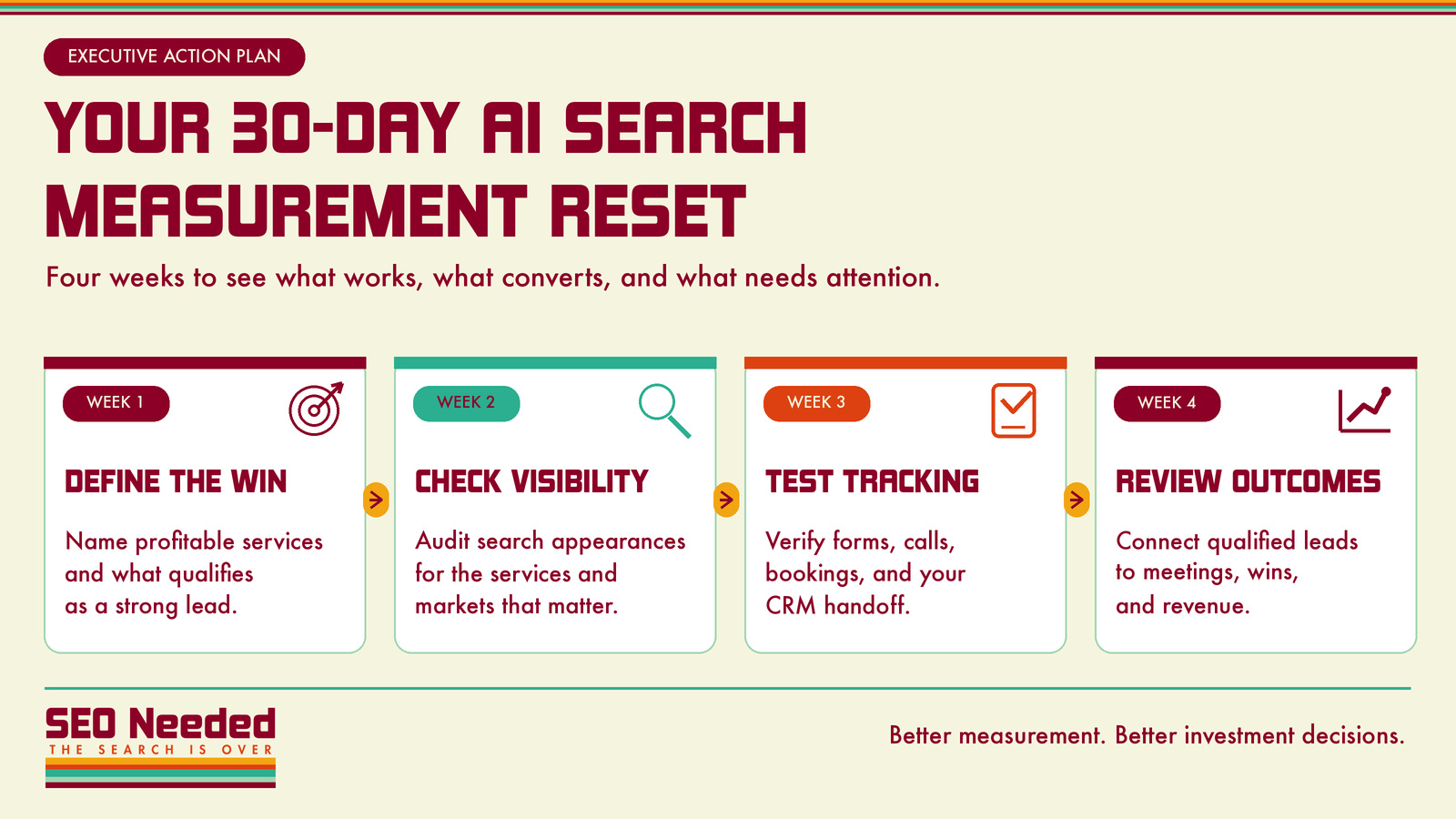
Week 1: Define the win. Name your three most profitable services or booking categories. Agree on what makes an inquiry qualified, including geography, scope and budget fit where appropriate.
Week 2: Check your visibility baseline. Review relevant landing pages in Search Console and Bing Webmaster Tools. Record which valuable topics appear in AI reports, and flag pages that need clearer service information. Don’t confuse appearing with earning business.
Week 3: Test your tracking. Confirm that real forms, appointment requests, and calls are recorded. Review GA4 key events and map those actions to stages in your CRM. Use Google’s recommended lead events where technically appropriate. [5][6]
Week 4: Review the full funnel. Compare visibility trends with genuine inquiries, qualification rates, meetings, proposals, and closed work. Document gaps and decide what to improve next: search targeting, landing-page clarity, conversion paths, or follow-up.
The purpose of this process is not to manufacture an impressive dashboard. It is to help you make better decisions about where to invest.
One practical point matters here: an October contract does not create an October head start unless implementation begins.
Assign an internal owner with the authority to move the work forward. Delayed access, unanswered questions, and stalled approvals can undermine the very timing advantage you are investing in.
What Should Leadership Measure in Q1?
Distinguish between early indicators and commercial outcomes.
Early indicators might include greater visibility for relevant searches, more visits to priority service pages, and stronger engagement with those pages. Commercial outcomes should focus on qualified inquiries, consultations, proposals, closed business, and acquisition costs.
Not every increase in traffic deserves a larger budget. Equally, a campaign should not be judged solely on closed revenue before your normal sales cycle has had time to run.
Ask for reporting that separates those stages. Compare results with the starting baseline and, where available, the prior-year period to help account for seasonality. Avoid attributing every improvement to SEO without examining other activity.
The question for the executive review should be:
Are we becoming more visible to the clients we want—and is that visibility contributing to business opportunities worth pursuing?
SOURCES & REFERENCES
[1] Pew Research Center, July 22, 2025, Google users are less likely to click on links when an AI summary appears in the results — https://www.pewresearch.org/short-reads/2025/07/22/google-users-are-less-likely-to-click-on-links-when-an-ai-summary-appears-in-the-results/
[2] Google Search Central, June 3, 2026, updated August 31, 2026, Introducing Search Generative AI performance reports in Search Console — https://developers.google.com/search/blog/2026/06/gen-ai-performance-reports
[3] Microsoft Bing Webmaster Blog, February 10, 2026, Introducing AI Performance in Bing Webmaster Tools Public Preview — https://blogs.bing.com/webmaster/2026/2/Introducing-AI-Performance-in-Bing-Webmaster-Tools-Public-Preview/
[4] Microsoft Bing Blog, June 16, 2026, New AI Visibility Insights in Bing Webmaster Tools — https://blogs.bing.com/search/2026/6/New-AI-Visibility-Insights-in-Bing-Webmaster-Tools-Intents-Topics-Citation-Share-Compare/
[5] Google Analytics, Recommended events (generate_lead, qualify_lead, close_convert_lead) — https://developers.google.com/analytics/devguides/collection/ga4/reference/events
[6] Google Analytics Help, About key events — https://support.google.com/analytics/answer/9267568
[7] Google Search Central, AI Features and Your Website — https://developers.google.com/search/docs/appearance/ai-features
Frequently Asked Questions
Are AI search impressions the same as website visits?
No. An impression indicates an appearance in a supported reporting context. A visit requires someone to reach your website. Neither one tells you by itself whether that visitor was qualified or became a customer. [2]
Can Bing AI citation counts tell me how many leads I received?
No. Microsoft’s AI Performance reports show citation activity and related context across supported experiences; they are not a CRM, sales report, or universal measurement of every AI assistant. [3][4]
What is the most important SEO metric for a high-ticket service company?
There isn’t one universal number. I recommend measuring qualified opportunities tied to valuable services, followed by their progression to consultations, signed business, and profit contribution. Rankings, impressions, and citations help explain how discovery is developing; they are supporting indicators rather than the finish line.