

If your leadership team expects stronger lead generation in Q1, the planning—and the work—should begin before January.
The final quarter of 2026 is more than a deadline for closing business and finalizing budgets. It is an opportunity to put next year’s growth strategy into motion. For established service businesses, professional firms, and B2B companies, the question is not simply where to spend remaining marketing dollars. It is which investments should begin now to support the clients, contracts, and revenue you want to attract in 2027.
SEO belongs in that conversation—not as an isolated year-end campaign, but as part of a coordinated plan to strengthen search visibility, support buyer research, and create more opportunities for qualified prospects to find your business.
A Q4 start does not guarantee a surge in revenue by January. It does mean entering the new year with research, implementation, and measurement already underway rather than spending the first quarter getting started.
These five strategic moves connect your Q4 decisions to your Q1 priorities—and your broader 2027 growth plan.
1. Give Your 2027 SEO Strategy a Q4 Head Start
SEO Needs Time. Your 2027 Plan Should Account for It.
Google’s SEO Starter Guide explains that changes can take anywhere from hours to several months to be reflected in search results. Google also cautions that not every improvement produces a noticeable impact. In other words, SEO is not a switch that leadership can turn on when additional leads become urgent.
That timing creates the business case for starting in Q4.
An initiative that begins implementation in early October has approximately three months of work behind it by January and six months by the end of March. A January kickoff, by comparison, places the initial research, implementation, and learning inside the quarter you may already expect to deliver growth.
Those months can be used to identify valuable search opportunities, improve priority service pages, address technical obstacles, and establish meaningful performance baselines.
Starting in Q4 can put your business in a better position to begin seeing progress during Q1 2027. It does not guarantee first-page rankings or a specific revenue result by January. Google explicitly warns against providers who promise guaranteed rankings.²
The executive advantage is straightforward: start the work before the business needs its full contribution.
2. Strengthen Your Visibility Where Decision-Makers Research
Your Next Client May Be Researching Before Your Sales Team Hears From Them
For businesses selling expertise, complex services, or high-value engagements, visibility should support the buying process—not simply generate website visits.
Gartner’s May 2026 reporting on a survey of 645 B2B buyers found that 45% had used generative AI during a recent purchase, primarily to gather information about vendors and products. At the same time, 69% preferred to validate AI-generated insights with sales representatives.³ The findings point to a buying journey that combines independent research with human reassurance.
The implication for leadership is not that sales teams are becoming unnecessary. It is that your digital presence should help them enter better-informed conversations.
Consider what a prospective client should be able to learn before contacting your company:
Does your organization serve businesses like theirs? What problems do you solve? What expertise supports your recommendations? What does an engagement involve? Why should they trust you with a consequential decision?
A commercially focused SEO strategy should make those answers easier to find.
That means prioritizing the services, markets, and questions connected to your growth objectives—not publishing content simply to fill a calendar. Google’s guidance similarly emphasizes useful, original content that demonstrates genuine expertise rather than repeating information already available elsewhere.⁴
For a high-value service business, the objective should not be “more traffic” in isolation. It should be more opportunities to reach the right decision-makers with a credible reason to choose you.
AI Search Makes the SEO Foundation More Relevant—not Less
Executives planning for 2027 may be asking whether to invest in traditional SEO or shift resources toward AI visibility.
On Google, those are connected priorities.
Google’s current guidance states that SEO best practices remain relevant to generative AI search because these experiences rely on its core search ranking and quality systems. Clear technical structure and valuable, expert-led content remain foundational. Meeting the requirements, however, does not guarantee inclusion.⁴
The practical recommendation is to coordinate SEO and AI-search planning rather than delay foundational improvements while debating terminology.
For your 2027 plan, that means asking your marketing team or agency to explain how its work supports relevant discovery, demonstrates your expertise, and helps prospective clients evaluate your business.
The investment should be in making your organization easier to understand and assess—not in chasing an acronym.
3. Align Your Marketing Investment With Revenue Priorities
Treat Q4 as the Launch of a Growth Initiative, Not a Year-End Campaign
A Q4 SEO investment becomes more compelling when it connects to an ongoing business plan.
Our recommendation is to establish an initial six-month execution horizon, supported by monthly reviews and a broader 2027 roadmap. That is a planning recommendation, not a promise that every campaign will produce a particular return within six months.
The budget should cover implementation and improvement—not just an audit that nobody acts on.
Before approving the investment, leadership should establish three priorities:
- Commercial focus: Which services, client types, and markets are most important to profitable growth?
- Execution ownership: Who will provide access, approve content, and ensure recommendations are implemented?
- Business measurement: How will the organization connect visibility and inquiries to qualified opportunities and revenue?
This also means giving SEO a defined role within the larger marketing plan.
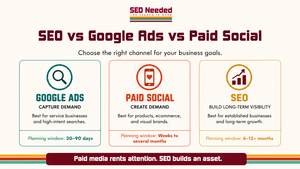
Do not make one channel responsible for every objective. Paid campaigns, referral development, sales outreach, and SEO should each have a purpose and an appropriate evaluation period.
The goal is to stop asking every channel to perform the same job.
4. Establish a Q4–Q1 Execution Plan With Clear Performance Measures
A Practical Q4-to-Q1 Roadmap
Use the following as an implementation framework—not a guaranteed ranking or revenue schedule.
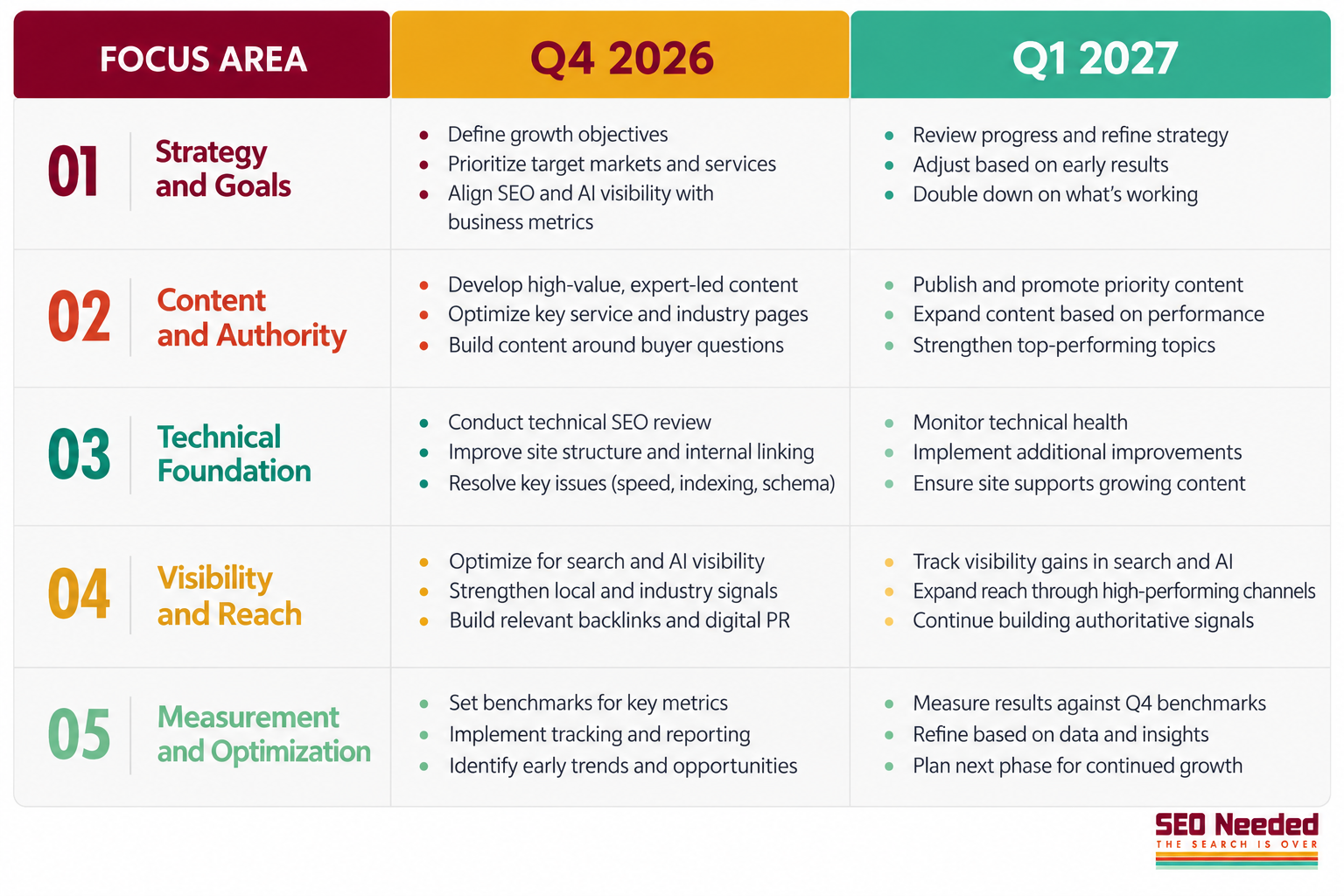
One practical point matters here: an October contract does not create an October head start unless implementation begins.
Assign an internal owner with the authority to move the work forward. Delayed access, unanswered questions, and stalled approvals can undermine the very timing advantage you are investing in.
What Should Leadership Measure in Q1?
Distinguish between early indicators and commercial outcomes.
Early indicators might include greater visibility for relevant searches, more visits to priority service pages, and stronger engagement with those pages. Commercial outcomes should focus on qualified inquiries, consultations, proposals, closed business, and acquisition costs.
Not every increase in traffic deserves a larger budget. Equally, a campaign should not be judged solely on closed revenue before your normal sales cycle has had time to run.
Ask for reporting that separates those stages. Compare results with the starting baseline and, where available, the prior-year period to help account for seasonality. Avoid attributing every improvement to SEO without examining other activity.
The question for the executive review should be:
Are we becoming more visible to the clients we want—and is that visibility contributing to business opportunities worth pursuing?
5. Put Remaining Year-End Funds to Work Strategically
Have Remaining Year-End Funds? Consider the Tax Treatment, but Start With the Business Case.
For U.S. businesses reviewing year-end spending, SEO may also belong in the conversation with the finance team and tax adviser.
The IRS states that deductible business expenses must generally be ordinary and necessary: common and accepted in the business, and helpful and appropriate to its operations. Its Tax Guide for Small Business also lists advertising among expenses that may be deductible. An ongoing SEO or content-marketing engagement is therefore worth reviewing with your CPA as a potential marketing expense—not assuming every component automatically qualifies.
That can make beginning already-needed work before year-end worth considering. But three distinctions matter.
A deduction is not reimbursement. Deductions reduce taxable income; they do not reduce your tax bill dollar for dollar by the amount spent.⁶ A marketing investment still needs to justify its cost.
Payment timing is not the only consideration. Your accounting method, tax year, the nature of the services, and rules for prepaid expenses can affect when a deduction is available. Paying a 2027 contract before December 31, 2026, does not automatically make the entire payment deductible in 2026.⁷
The specific work matters. Have your tax adviser review the scope, service dates, invoices, and any prepayment arrangement before treating the expenditure as a current-year deduction.
The strongest argument is not, “Spend money before the year ends.”
It is:
“Begin a commercially justified investment now, give it more time to contribute to next year’s growth, and confirm whether its tax treatment provides an additional benefit.”
That is a more disciplined use of year-end resources than spending simply to consume a budget.
These are general U.S. federal tax considerations, not tax advice for a specific business.+
Enter 2027 With More Than an Approved Marketing Budget
A January planning meeting cannot replace the work that could have been completed in October, November, and December.
For leadership teams with defined growth goals, Q4 is an opportunity to begin execution, establish accountability, and enter the new year with a clearer understanding of what needs to improve.
SOURCES & REFERENCES
- Google Search Central — Search Engine Optimization (SEO) Starter Guide
Guidance on SEO fundamentals and implementation timelines, including why website changes may take several months to be reflected in search results. Google for Developers
- Google Search Central — Do You Need an SEO?
Guidance on evaluating SEO providers, establishing realistic expectations, and avoiding promises of guaranteed rankings. Google for Developers - Gartner — Gartner Survey Finds 69% of B2B Buyers Turn to Sales Reps to Validate AI-Generated Insights
Published May 20, 2026, based on a survey conducted in August–September 2025. Supports the article’s discussion of buyers combining AI-assisted research with human validation, including the 45% AI-use and 69% sales-validation findings. Gartner - Google Search Central — Google’s Guide to Optimizing for Generative AI Features on Google Search
Explains why foundational SEO, original expert-led content, and a clear technical structure remain relevant to visibility in Google’s generative AI search experiences. Google for Developers - Internal Revenue Service — Publication 334: Tax Guide for Small Business
Explains the ordinary-and-necessary standard for business expenses and identifies advertising among expenses that may be deductible. IRS - Internal Revenue Service — Credits and Deductions
Explains the distinction between credits that reduce tax due and deductions that reduce taxable income. Supports the article’s clarification that a deduction is not reimbursement for marketing spending. IRS - Internal Revenue Service — Publication 538: Accounting Periods and Methods
Covers accounting methods, expenses paid in advance, and rules affecting when business expenses may be deducted. Supports the recommendation to consult a CPA before prepaying for marketing services for tax purposes. IRS
Frequently Asked Questions
Can starting SEO in Q4 produce results in Q1 2027?
It can create an opportunity for early progress, but timing and outcomes vary. Google says changes can take several months to be reflected and may not produce a noticeable impact.¹ Treat Q1 as a review point—not a guaranteed deadline for rankings or revenue.
Should SEO come from the remaining 2026 budget or the 2027 marketing plan?
Consider both: a defined Q4 implementation budget and ongoing 2027 funding tied to business priorities. Avoid launching work in December without deciding who will continue, measure, and improve it in January.
Is prepaying for SEO before year-end automatically tax-deductible?
No. Deductibility and timing depend on the circumstances, including accounting methods and prepaid-expense rules.⁷ Your CPA should confirm the treatment before you make an advance payment for tax purposes.