

Which marketing channel is best for where my business is right now?
If you have $1,000 to spend on marketing, where should you put it?
SEO?
Google Ads?
Facebook or Instagram ads?
The answer is not simply, “Pick the channel with the highest average ROI.”
Each channel does a different job.
Here is the easiest way to understand the difference:
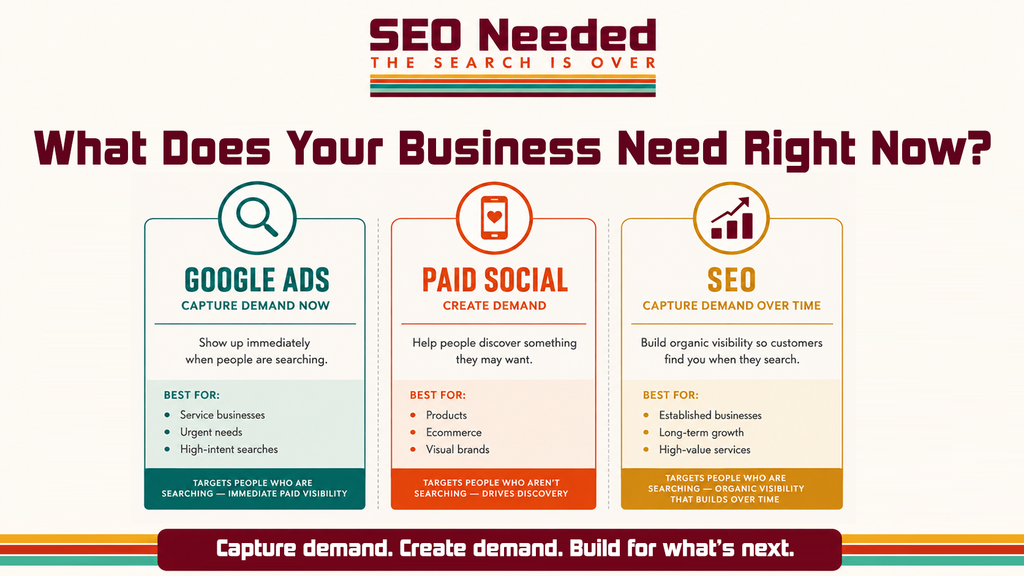
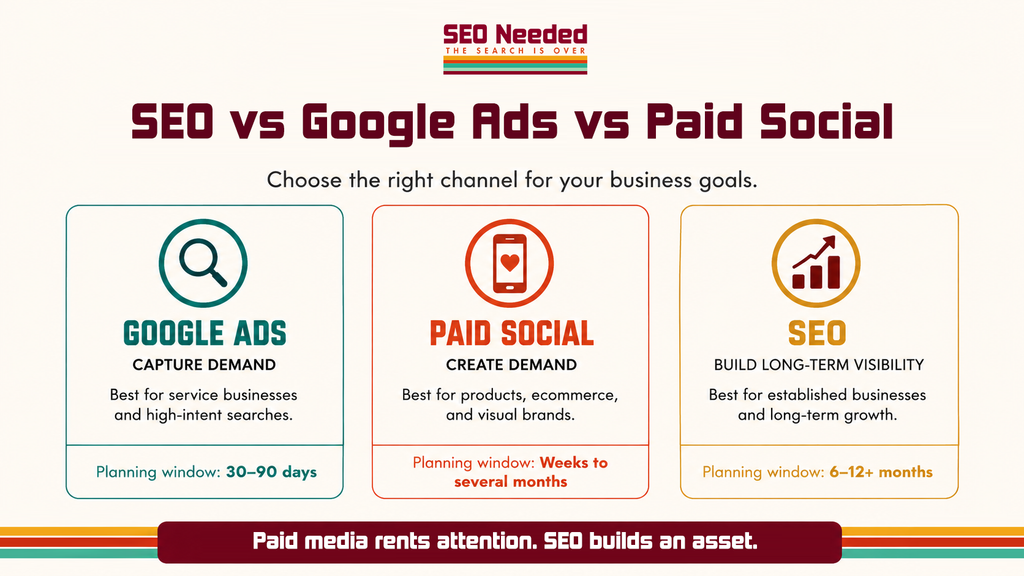
- Google Ads captures demand that already exists.
- Paid social helps create demand.
- Search Engine Optimization (SEO) builds visibility that can keep capturing demand over time.
That difference matters because the best marketing investment for a company that needs customers this month may be completely different from the best investment for a company trying to grow over the next three years.
The Quick Answer
Need leads now?
Start by considering Google Ads.
This is especially true for service businesses where people are already actively searching for the service.
Launching a new consumer product?
Consider paid social.
Facebook, Instagram, TikTok, and similar platforms can introduce a product to people who may not even know they want it yet.
Already have revenue and want sustainable growth?
Consider investing heavily in SEO.
SEO usually takes longer to produce a financial return, but unlike an advertising campaign, the visibility you build does not disappear simply because you stopped paying for every click.
First, What Does “ROI” Actually Mean?
Return on Investment (ROI) measures how much money an investment generates compared with what it cost.
The basic formula is:
ROI = (Revenue Generated − Marketing Cost) ÷ Marketing Cost × 100
But digital marketing reports often use another term:
Return on Ad Spend (ROAS).
ROAS measures revenue generated from advertising compared with advertising spend.
If you spend $1,000 on ads and generate $4,000 in attributable sales, your ROAS is 4:1.
That does not necessarily mean you earned $3,000 in profit.
Product costs, payroll, agency fees, software, sales commissions, overhead, and other expenses still matter.
That distinction becomes important when comparing SEO with advertising.
How the ROI of SEO, Google Ads, and Paid Social Compares
There is no reliable universal study that allows us to say:
SEO returns exactly X, Google Ads returns exactly Y, and social media returns exactly Z.
Different studies measure different industries, attribution windows, business models, revenue, profit, and campaign durations.
What we can compare is the return profile of each channel.
Google Ads: Faster Return, Ongoing Cost
Google’s Economic Impact methodology estimates that advertisers receive between approximately $2 and $2.30 in economic value for every $1 spent on Google Ads, with Google using the more conservative $2 figure in its reporting.
That does not mean every advertiser earns a 2:1 return.
What Google Ads offers is something equally important:
speed.
A well-built search campaign can begin appearing for relevant searches as soon as it is running.
Google notes that automated bidding systems may need as much as three weeks or one to two conversion cycles to adjust to a new objective.
So, while leads can start quickly, profitable optimization still takes data.
Simple way to think about it:
Google Ads = faster opportunity + continuous advertising expense.
Paid Social: Strong Discovery Potential
Paid social operates differently because the customer does not necessarily need to be searching.
An Instagram user may have had absolutely no intention of purchasing a new handbag, skincare product, meal-delivery service, or piece of furniture five seconds before seeing an ad.
Then the product appears.
Interest begins.
That makes paid social particularly powerful for consumer products and visually driven brands.
Meta reported in 2025 that its study of U.S. advertisers found an average of $3.71 in revenue generated for every advertising dollar, while advertisers using certain AI-driven advertising tools generated $4.52. Because the research comes from Meta, the figures should be viewed as a platform-specific benchmark rather than a guarantee of results.
Independent Nielsen research also found social media among the stronger-performing media categories for global ROI, while emphasizing that perceived measurability and actual effectiveness are not always the same thing.
Simple way to think about it:
Paid social = demand creation + constant testing.
SEO: Slower Return, Greater Compounding Potential
SEO has the opposite problem.
It is usually not fast.
Google itself warns that some website improvements may take several months for its systems to fully evaluate.
But once organic visibility is established, the business does not pay Google every time someone clicks an organic result.
Shopify’s 2025 guide to SEO ROI describes SEO as a compounding asset and notes that businesses can typically expect positive returns within a year, while acknowledging that results vary considerably. It also cites a three- to fivefold return over three years as a commonly used healthy SEO benchmark.
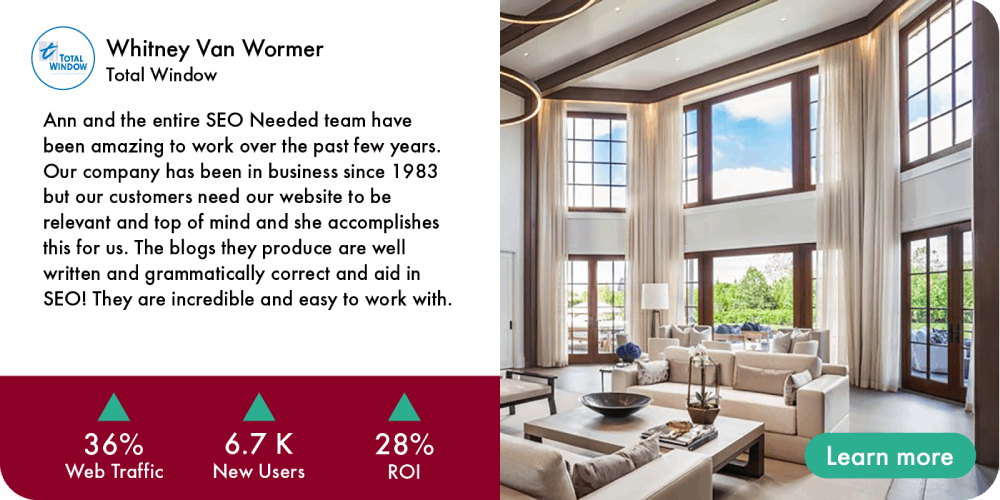
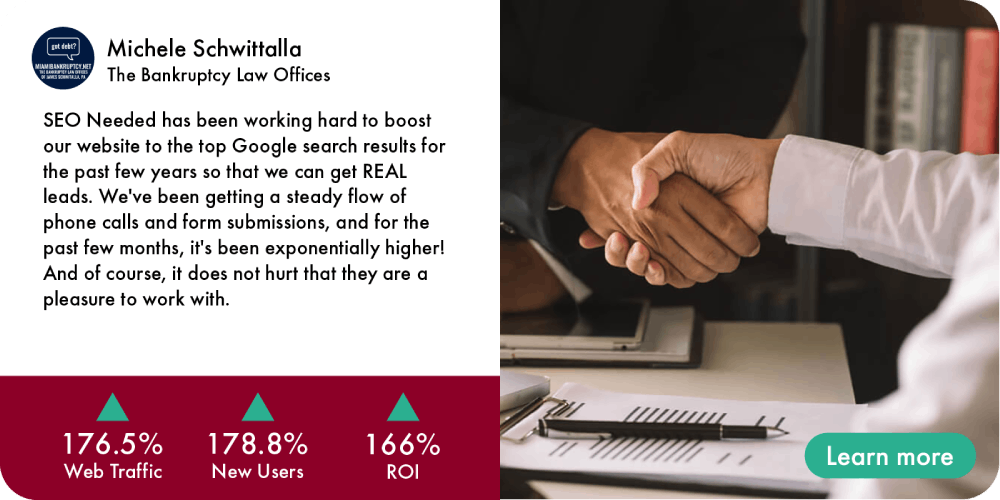
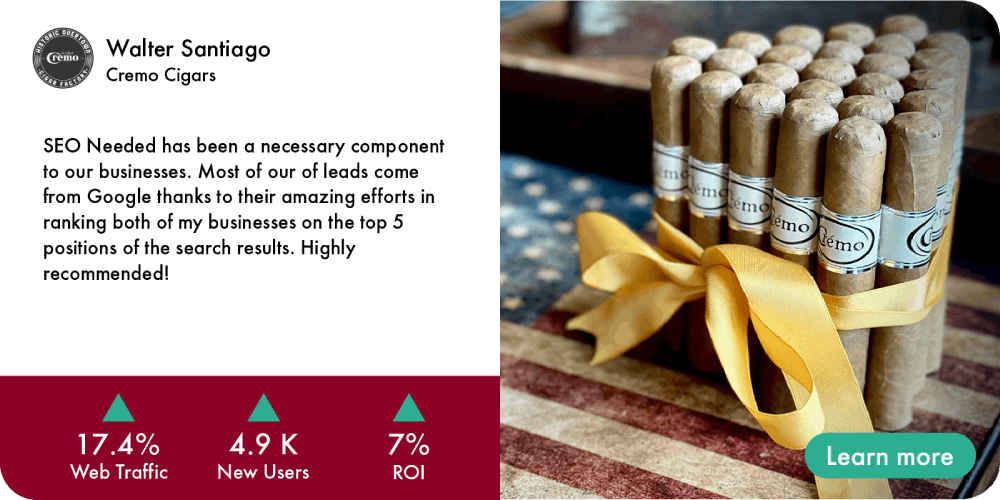
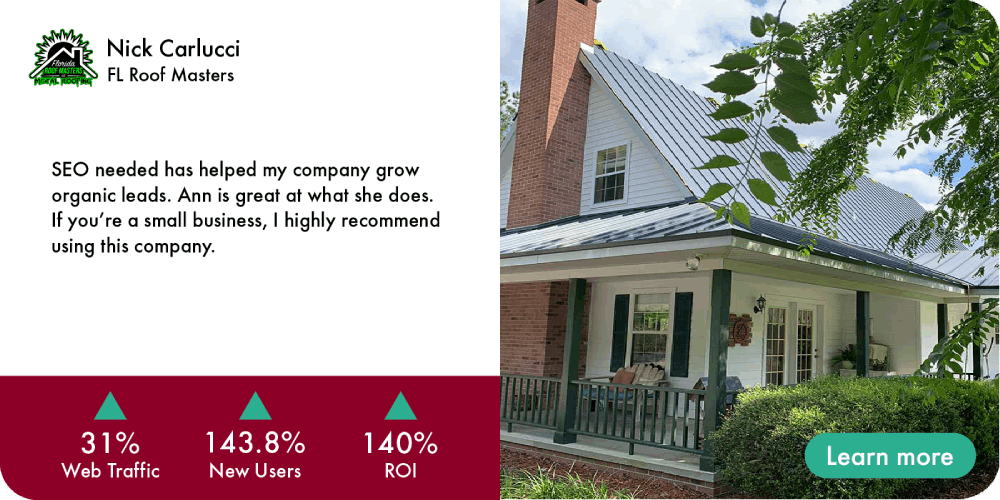
SEO Needed follows this same long-term philosophy with its Organic SEO strategies, which are designed to build sustainable search visibility rather than depend entirely on paid traffic.
Simple way to think about it:
SEO = slower start + compounding visibility.
When Should a New Service Business Use Google Ads?
Imagine you just opened a plumbing company.
Your website is new.
You have little domain authority.
You are not ranking prominently yet.
But people are searching for plumbers today.
Waiting months for organic rankings does not solve the immediate problem.
That is a situation where Google Ads can make sense.
Paid search puts your business in front of someone who has already expressed intent by searching.
For a startup service business, that immediate access to demand can be extremely valuable.
A Practical Profitability Window
Do not confuse “my ads are running” with “my ads are profitable.”
Google’s automated bidding systems need conversion information to optimize effectively and can take several weeks or multiple conversion cycles to learn.
For budgeting purposes, a new business should therefore be financially prepared for a testing and optimization period measured in weeks rather than days.
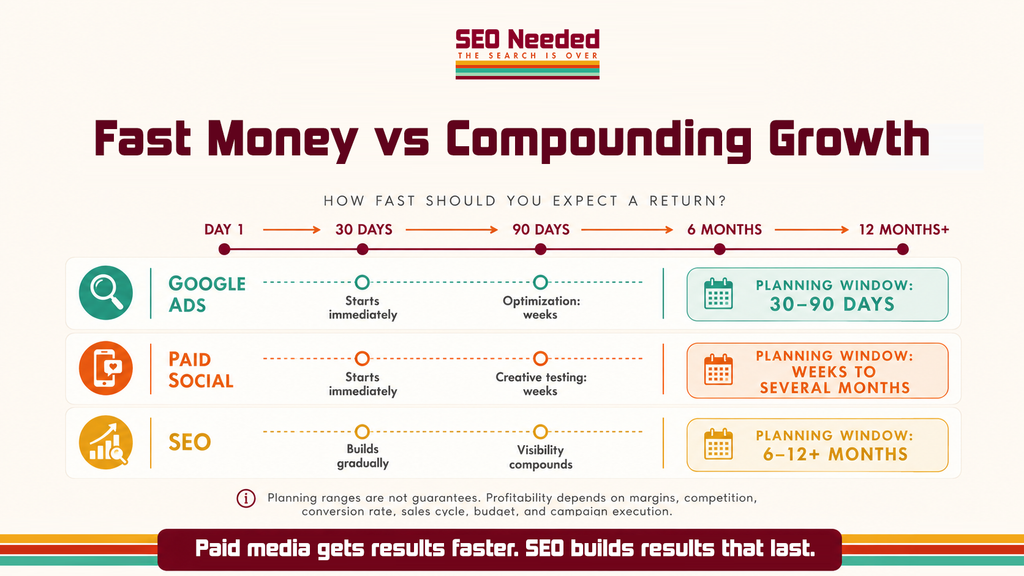
For many small businesses, planning around roughly 30–90 days of testing is more realistic than expecting the campaign to prove itself during the first week. That is a planning guideline, not an industry guarantee.
Google Ads is a strong first choice when:
- Customers already search for your service.
- You need leads relatively quickly.
- Each new customer is worth enough to justify acquisition costs.
- You have money available for testing.
- You can answer calls and follow up with leads quickly.
WATCH OUT
A business with literally no financial cushion should not assume Google Ads will immediately rescue its cash flow.
Paid search may be faster than SEO, but it still requires testing.
If losing the first $1,000 of advertising spend would put the business in financial trouble, the bigger problem may be insufficient marketing runway.
When Should a Product Startup Use Paid Social?
Now imagine you invented a new consumer product.
There is one problem.
Nobody knows it exists.
That means nobody is Googling its brand name yet.
Search advertising can capture existing demand.
Paid social can introduce something new.
Facebook, Instagram, and other social platforms allow a product to appear while customers are browsing content rather than actively searching.
That creates an opportunity for discovery.
A Practical Profitability Window
Social campaigns usually require testing different:
- Images
- Videos
- Headlines
- Offers
- Audiences
- Landing pages
Shopify recommends allowing social A/B tests to run long enough to gather meaningful data rather than declaring a winner immediately; its guidance recommends at least a week for individual tests to account for normal fluctuations.
Because several rounds of testing may be necessary, businesses should generally think in terms of weeks to a few months before deciding whether paid social has a repeatable profitable formula.
Paid social is especially attractive when:
- The product is visual.
- The product is easy to understand quickly.
- Consumers can purchase online.
- The product generates curiosity or emotion.
- Your audience spends significant time on social platforms.
- You can continually produce creative assets.
WATCH OUT
Not every product startup belongs on paid social first.
If customers are already actively searching for the product category — especially with strong purchase intent — Google Search or Google Shopping may deserve priority.
The question is not simply:
“Do I sell a product?”
The question is:
“Do customers search for this product, or do they need to discover it?”
When Should a Business Invest in SEO?
SEO becomes especially attractive once a business has proof that its business model works.
You already know customers want what you sell.
You have revenue.
You understand which services are most profitable.
You know what a qualified lead looks like.
Now you can invest in becoming easier to find when people search for those services.
That is where SEO becomes powerful.
Rather than paying for visibility one click at a time, the company invests in its own digital property:
its website, content, authority, technical foundation, local presence, and search visibility.
Google cautions that meaningful site-level improvements can require months to be reflected in search performance.
Shopify similarly notes that SEO returns may take months to materialize and that positive returns are commonly evaluated over a much longer time horizon than paid advertising.
A Practical Profitability Window
For financial planning, businesses should generally treat SEO as a 6–12+ month investment, rather than expecting it to fund itself during the first few months.
Some campaigns will produce leads sooner.
Competitive industries may take considerably longer.
What matters is that SEO is funded like a long-term growth strategy, not a short-term advertising campaign.
SEO becomes particularly attractive when:
- The business already has dependable revenue.
- Customers actively search before hiring or purchasing.
- One client or transaction is relatively valuable.
- The company plans to be in business for years.
- The business wants to decrease dependence on advertising.
- Competitors dominate search results.
- The company can consistently invest long enough for the strategy to mature.
The Mistake: Asking SEO to Behave Like Ads
This is one of the biggest marketing mistakes businesses make.
They start SEO.
Thirty days later, they ask:
“Where are my leads?”
That is like planting a mango tree on Monday and getting irritated because there were no mangoes on Friday.
Paid advertising and SEO operate on different clocks.
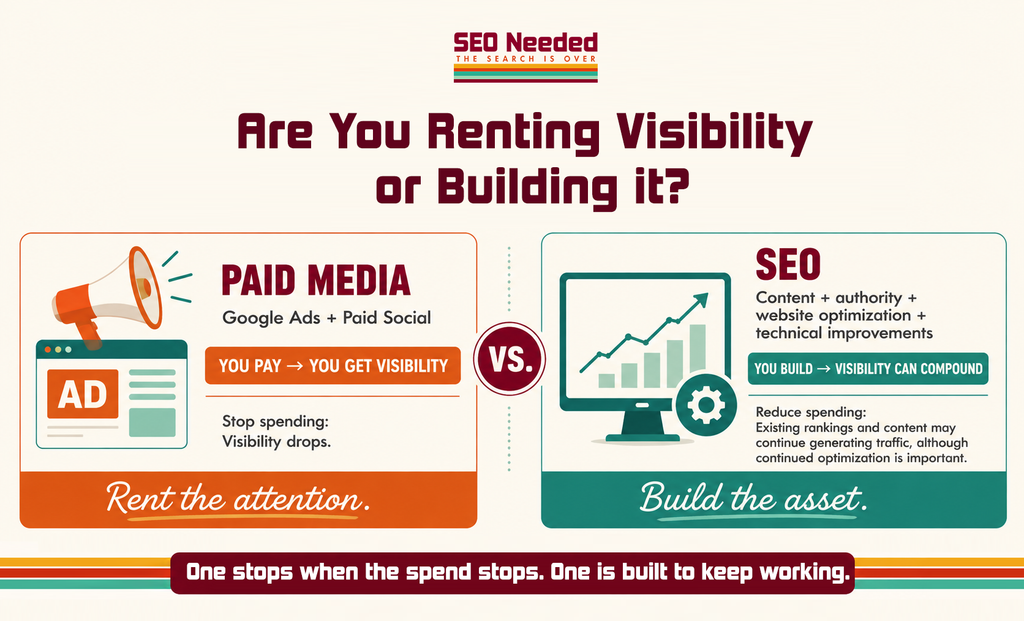
With Google Ads, you pay for immediate access to an existing audience.
With paid social, you pay to reach and test audiences.
With SEO, you are building an asset that needs time to establish visibility and authority.
Comparing all three after 30 days therefore gives paid media an unfair advantage.
Comparing them after several years may give SEO the advantage.
Time changes the ROI equation.
So Which One Should You Choose?
Use this simple decision tree.
“I just opened a service business and need customers.”
Consider Google Ads first.
Capture people who are already searching.
Then start building SEO as cash flow and marketing runway improve.
“I launched a new consumer product.”
Consider paid social first.
Show people something they may not have known they wanted.
Then layer in search as brand and product-category demand develops.
“My company is established and I want consistent long-term growth.”
Prioritize SEO.
You have the runway to invest today for visibility that can continue producing opportunities later.
“We have the budget to do more than one.”
Good.
This is where the strongest strategy often emerges.
Because the real answer is rarely:
SEO or advertising.
It is more often:
Which one should we use first, and what job should each channel perform?
The Smart Marketing Sequence
A growing service company might use:
Google Ads → SEO → Google Ads + SEO
Paid search creates immediate opportunities.
SEO gradually builds organic visibility.
As SEO matures, Google Ads can be used more selectively for new services, competitive searches, promotions, or markets where organic visibility is still developing.
A growing ecommerce company might use:
Paid Social → Paid Search/Shopping → SEO
Social creates awareness.
Search captures growing demand.
SEO then builds category, product, informational, and brand visibility over the longer term.
There is no rule saying you must choose only one.
The goal is to stop asking every channel to perform the same job.
TLDR
If your business needs speed, paid media usually wins.
If your business needs discovery, paid social can be extremely powerful.
If your business wants long-term compounding visibility, SEO deserves serious investment.
And if your business has enough budget?
The smartest strategy may be to use all three strategically.
Paid media can help you generate opportunities today.
SEO can help make sure you are not paying for every opportunity forever.
For businesses ready to build a long-term search presence, learn more about SEO Needed’s Organic SEO services.
SEO Needed helps businesses improve visibility across traditional search and emerging AI-driven discovery through Search Engine Optimization (SEO), Artificial Intelligence Optimization (AIO), Answer Engine Optimization (AEO), and Generative Engine Optimization (GEO).
Ready to determine which visibility strategy makes the most financial sense for your business? Contact SEO Needed.
The Search is Over.