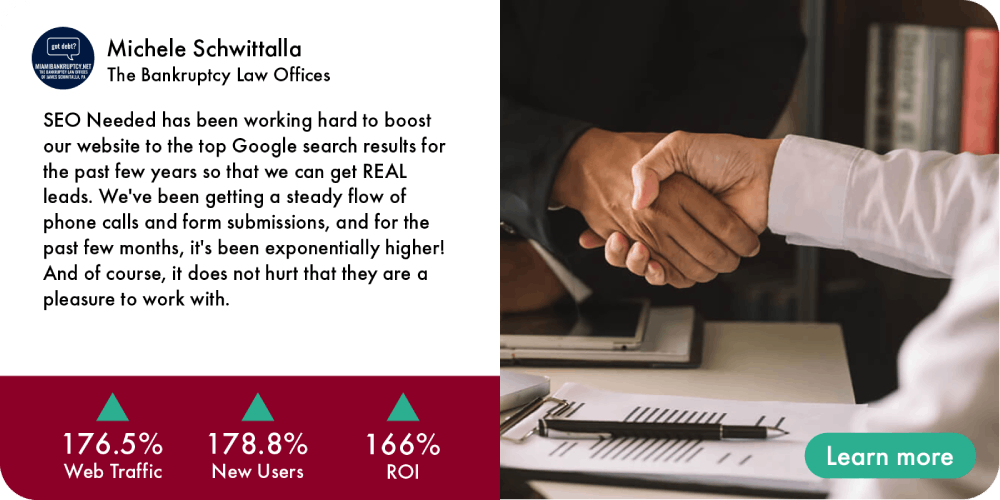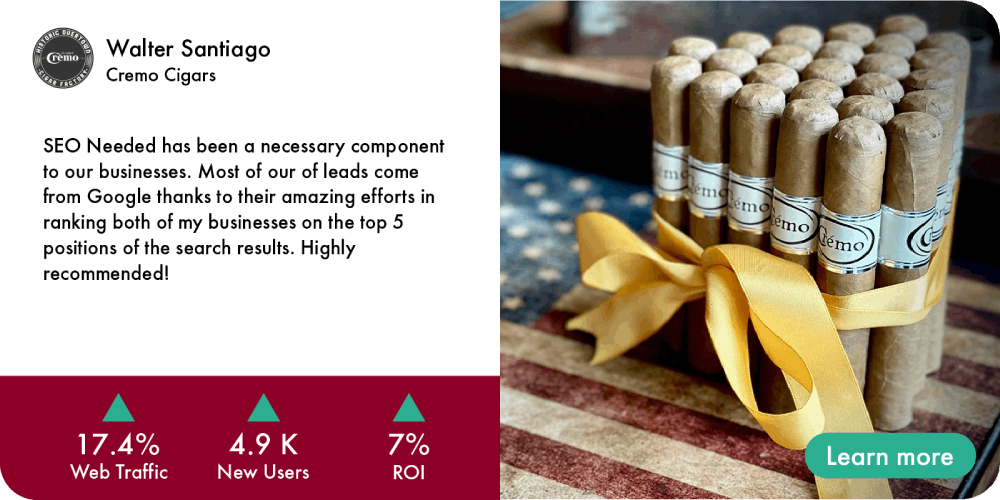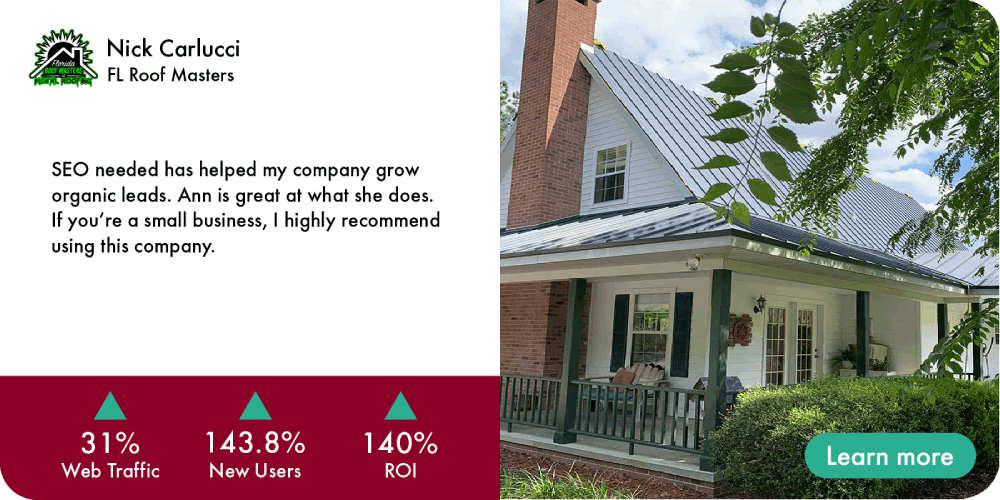


A five-star reputation can start a business relationship, but it rarely answers every question a high-value buyer has. Before choosing a law firm, approving a commercial roofing proposal, or booking a premium venue, people want to know something more specific: Can this company handle my situation, and do I trust it enough to make contact?
I see this gap when I review websites for established service businesses. The company may have excellent people and a strong reputation, yet its website offers vague service descriptions, generic photos, outdated details, and an inquiry form that asks for almost nothing useful. The marketing looks active. The case for choosing the business is still incomplete.
BrightLocal’s February 2026 Local Consumer Review Survey found that 54% of surveyed U.S. adult consumers said they would visit a business’s website after reading positive reviews. That is not a statistic about senior executives specifically, and it does not prove that every visit becomes a lead. It does reinforce a practical point: a review often begins the evaluation rather than ending it. [1]
The discovery-to-decision gap
Search discovery is no longer a single straight line. A buyer might first see a company in Google Maps, read a recommendation in an AI assistant, visit a review profile, then compare two service pages before making contact. The sequence differs by person and market, but accuracy and consistency matter at every stop.
BrightLocal’s March 2026 AI review study adds useful context: among its 455 respondents who had used AI tools for local business recommendations, 88% checked the legitimacy of reviews or their cited sources. The subgroup is not a representative sample of corporate purchasing committees; it is evidence that AI-assisted discovery does not eliminate verification. [2]
Google’s own guidance asks site owners to create original, reliable, people-first content and to make expertise and the people responsible for the content clear where that helps readers. That is a useful editorial standard – not a secret shortcut to AI recommendations. [3]
My 5-point Buyer Trust Test
Open your most important service page on a phone. Pretend you are a qualified prospect who has never met your team. Can you pass these five checks without making the visitor hunt for answers?
1. FIT: Is it immediately clear who you help?
A visitor should understand your service, your geography, and the kind of project or matter you take on within a few seconds. ‘Quality solutions for every need’ does not tell a facilities director whether you replace commercial roofs. ‘Full-service legal counsel’ does not tell someone whether you handle the specific transaction or legal matter they face.
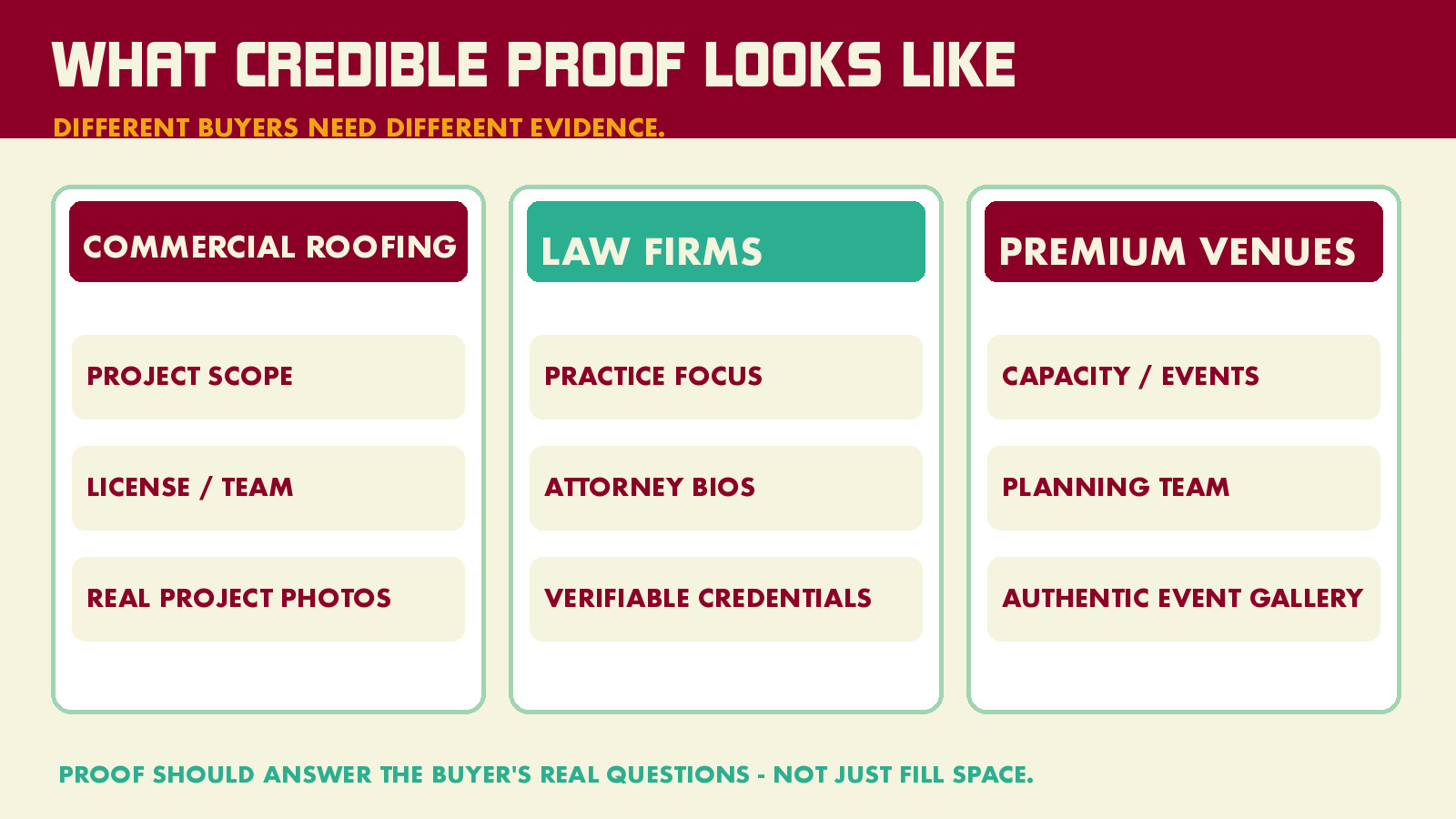
Make your page headline and first paragraph specific. Explain who qualifies, which problems you address, and any meaningful scope boundaries. For a premium venue, include capacity, event types, relevant location information and the experience you offer – not just beautiful photography.
2. PEOPLE: Can the prospect verify your expertise?
Show the actual people and qualifications behind the work. For a law firm, that may mean current attorney biographies, relevant practice focus and properly described credentials. For a contractor, it may mean verifiable licenses, insurance information where appropriate, the types of projects completed and the leaders responsible for delivery. A venue may benefit from introducing the team that plans and executes events.
Use precise, supportable language. ‘Experienced team’ is a claim; a named professional, accurately described experience, and a relevant credential help the visitor evaluate that claim.
3. PROOF: Is the evidence relevant to the buyer?
A star rating is useful, but it is not a substitute for the right evidence. Include genuine reviews, permission-cleared project examples, specific service details, professional affiliations when current, and practical explanations of what working together looks like. Never manufacture testimonials, suggest every customer gets the same outcome, or publish confidential client information.
If you have strong proof but cannot share client names, explain the work at an appropriate level of detail and obtain required permissions. A commercial building owner may want to see comparable scope and safety considerations; a corporate event buyer may want to understand logistics and production capability.
4. CONSISTENCY: Do your public profiles tell the same story?
Compare your website with your Google Business Profile, relevant industry directories, leadership bios and other public information. Names, locations, services, hours, credentials and contact details should not contradict one another. If an important service appears in one place but not another, a buyer may wonder which information is current.
Google states that complete and accurate Business Profile information helps local businesses appear in relevant results, and that local rankings are mainly based on relevance, distance and prominence. Reviews and positive ratings can contribute to prominence, but there is no pay-to-rank shortcut. Treat profile accuracy as a service to both customers and search systems. [4]
5. NEXT STEP: Can a qualified prospect move forward easily?
Once a visitor feels confident, do not make the next step mysterious. Show the right action for the service: request a commercial estimate, schedule a legal consultation, ask about venue availability, or book a planning call. State what happens next and what information is helpful to provide.
Test the entire journey on a phone. Does the form submit? Does the confirmation work? Does the team respond? Keep sensitive legal, health, or personal information out of ordinary analytics. A trusted website and a weak follow-up process can still lose the opportunity.
What convincing proof looks like in three high-value industries

A 15-minute executive trust audit
You do not need a new website to start. Give each of the five checks a simple score: 0 if the answer is missing or inaccurate, 1 if it is present but weak, and 2 if a first-time visitor can verify it quickly. This is my practical prioritization tool, not a scientific trust score or a prediction of search rankings.
- Open the three most valuable service pages on mobile. Score FIT, PEOPLE, PROOF, CONSISTENCY and NEXT STEP.
- Ask someone outside your company to answer, without coaching: What does this business do, who does it serve, why trust it, and how do I start?
- Fix factual errors first. Then strengthen the weakest proof point on the page with the greatest commercial value.
- Track changes in qualified inquiries and actual conversations over time; do not assume a page edit caused every change in sales.
A note on reviews: build trust without manipulating it
Google allows businesses to invite customers to share genuine experiences and provides review links and QR codes. It prohibits incentives for posting, revising or removing reviews. Public responses should be professional and protect privacy. [5]
The FTC’s Consumer Reviews and Testimonials Rule also addresses fake or false reviews, undisclosed insider reviews and other deceptive practices. It is safer to build a repeatable process for honest feedback than to chase an artificially perfect score. [6]
Does this also help SEO and AI search?
Clear service descriptions, useful original evidence, accurate business details and trustworthy reviews can make a business easier for people to evaluate. They also align with elements of Google’s published search and local business guidance. However, no five-step checklist guarantees a top Google ranking, a ChatGPT recommendation, inclusion in an AI answer or a particular number of leads. Search systems differ and may change.
My recommendation is to solve the buyer’s question first: ‘Is this business right for me, and can I verify its claims?’ Search optimization should support that answer instead of obscuring it with buzzwords.
Sources
[1] BrightLocal, Local Consumer Review Survey 2026 – February 11, 2026
Representative panel of 1,002 U.S. adult consumers; 54% likely to visit a website after reading positive reviews.
https://www.brightlocal.com/research/local-consumer-review-survey/
[2] BrightLocal, Nearly Half of Consumers Are Asking AI for Business Recommendations – March 10, 2026
AI-user subgroup of 455 respondents; 88% check review legitimacy or cited sources.
https://www.brightlocal.com/research/lcrs-ai-trust/
[3] Google Search Central, Creating Helpful, Reliable, People-First Content – Current documentation, accessed October 21, 2026
Primary guidance on originality, reliability, expertise and people-first content.
https://developers.google.com/search/docs/fundamentals/creating-helpful-content
[4] Google Business Profile Help, Tips to Improve Your Local Ranking on Google – Current documentation, accessed October 21, 2026
Relevance, distance and prominence; accurate information and reviews.
https://support.google.com/business/answer/7091?hl=en
[5] Google Business Profile Help, Tips to Get More Reviews – Current documentation, accessed October 21, 2026
Genuine reviews, no incentives, responsible replies.
https://support.google.com/business/answer/3474122?hl=en
[6] FTC, Consumer Reviews and Testimonials Rule: Questions and Answers – Federal rule effective October 21, 2024; accessed October 21, 2026
Deceptive and fake reviews/testimonials, insider disclosures and related guidance.
https://www.ftc.gov/business-guidance/resources/consumer-reviews-testimonials-rule-questions-answers
Frequently Asked Questions
Are five-star reviews enough to win high-value clients?
Not necessarily. Reviews can create confidence, but buyers may still need evidence of service fit, credentials, relevant experience, availability and a clear next step. BrightLocal’s consumer survey suggests many people continue to research after positive reviews. [1]
Will adding testimonials make ChatGPT recommend my business?
There is no reliable guarantee. Genuine, accessible and accurate information helps people evaluate you, but AI recommendations depend on the platform, question, sources and many factors outside a business’s control. Never fabricate social proof to influence a system.
What should a company do first if its website feels unconvincing?
Start with your highest-value service page. Make the offer and audience clear, verify public facts, replace vague claims with substantiated proof, and test the contact path on a mobile device. Then measure the quality of resulting inquiries, not just the number of visitors.